Skip to main content Skip to main navigation Skip to footer
Insights
DrupalCon Rotterdam Recap

Three days at DrupalCon. And quite a lot that’s stuck with us.

On AI, Canvas and the future of software development. On a community that needs to redefine itself. And on a realisation that sums up a great deal: Drupal is light years ahead of its public perception in technological terms.

Max and Chrissi at DrupalCon

Three days of DrupalCon Europe in Rotterdam are now behind us. Three days packed with talks, discussions, new ideas and encounters – and with the rather reassuring realisation that, technologically speaking, Drupal is currently doing a lot of things right.

Or, as it was so aptly put at DrupalCon: “Drupal is lightyears ahead of its reputation.”

That hits the nail on the head. Whilst outside the Drupal bubble people are still debating whether Drupal is even relevant, the community has long been exploring AI agents, new interfaces, modern site-building concepts and the question of what software development will look like as more and more code is written by machines.

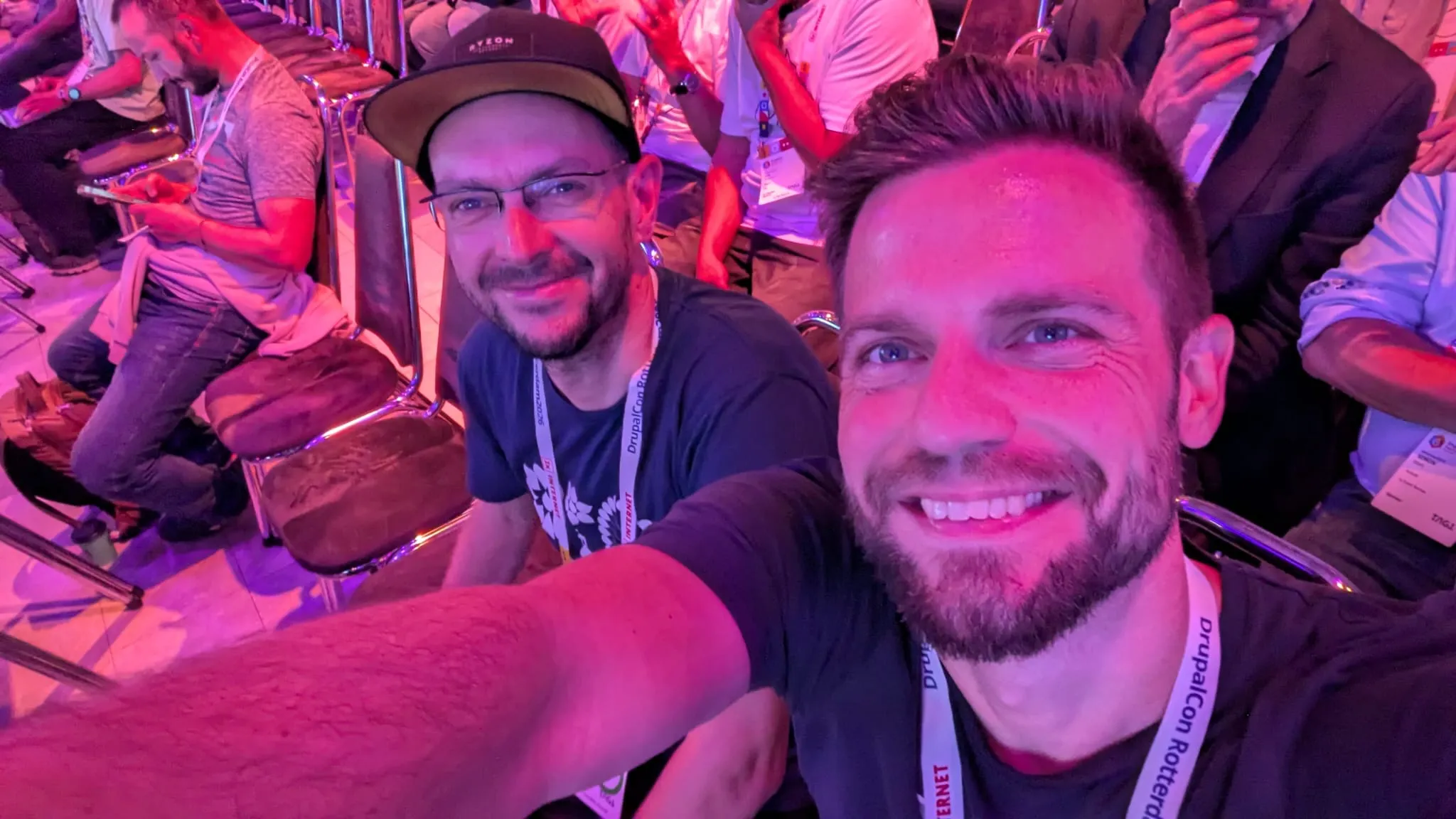
Christopher and Max were in Rotterdam on behalf of BRANDCODE. That really stuck with us.

Drupal can do more. Now someone just needs to tell people about it.

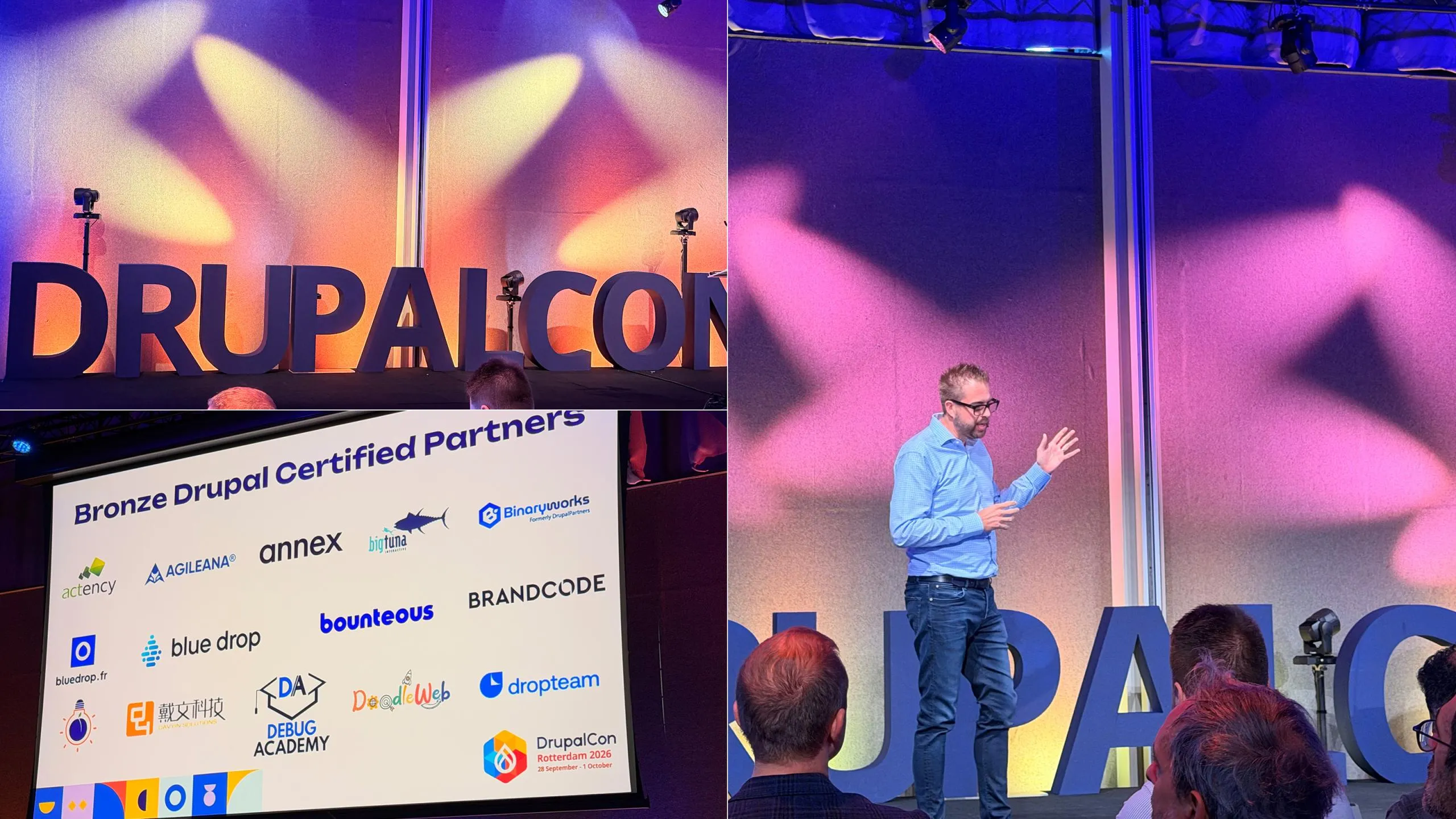
A regular feature of every DrupalCon is the Driesnote, the keynote speech by Drupal founder Dries Buytaert. This time, one topic in particular stuck with us – one that doesn’t sound particularly technical at first: Drupal needs to get better at talking about Drupal.

What’s interesting is that this is exactly what we’ve discussed internally on several occasions.

The Drupal community has long had a credit system for work on issues. This primarily highlights technical contributions. Anyone who organises events, shares knowledge, brings people together or promotes Drupal through communication also contributes to the project – but this work has so far remained very much in the shadows.

The Drupal Advocacy Programme aims to change that. Dries explicitly called on the community to report more on Drupal and to raise the profile of the project’s development.

And this is indeed necessary. Drupal has evolved enormously from a technological perspective in recent years and is, for example, extremely advanced when it comes to integrating AI. Public perception hasn’t necessarily kept pace with this.

You only have to type “Is Drupal …” into Google and see what the autocomplete suggests: “dead?”, “still relevant?” and similar questions.

All right then, Dries. We’ve got the message. Here’s our DrupalCon recap.
A speaker gives a presentation at a conference

AI has long since become more than just a buzzword

Naturally, Driesnote 2026 couldn’t do without AI either. What’s more exciting than the mere presence of the topic, however, is just how concrete the applications are becoming.

With the Drupal AI Demo, for example, you can try out a fully configured Drupal system with integrated AI functions straight away. This significantly lowers the barrier to engaging with the possibilities in practice, rather than just in theory.

We find another idea even more interesting: agents are another interface to Drupal.

Instead of clicking your way through a backend to find the right function, you could simply tell an agent what you want to happen in Drupal. Create, edit or manage content – using natural language via ChatGPT and similar tools.

There’s already a Drupal module for this called Agent Access. We’ll have to give that a go.

When machines do the programming, the role of developers changes

Given the sheer number of sessions at a DrupalCon, it’s not always easy to say in hindsight which talks actually made an impact. Two in particular have stuck in our minds.

One of them was “Clean Code in the Age of AI: Writing for Humans When Machines Write the Code” by Len Swaneveld (@lendude).

We didn’t hear anything radically new there. And that, in fact, was the good news.

This engaging talk for real developers confirmed much of what we’re currently experiencing in our own day-to-day work: developers are writing less code entirely on their own. Instead, their role is shifting increasingly towards evaluating, questioning and improving the outputs of LLMs – and taking responsibility for them.

The ability to recognise good code and truly understand software architecture is no less important as a result. On the contrary.

Or, in Dries’ words: “Never commit anything you don’t understand.”

‘Human in the Loop’ is simply not a stopgap solution.

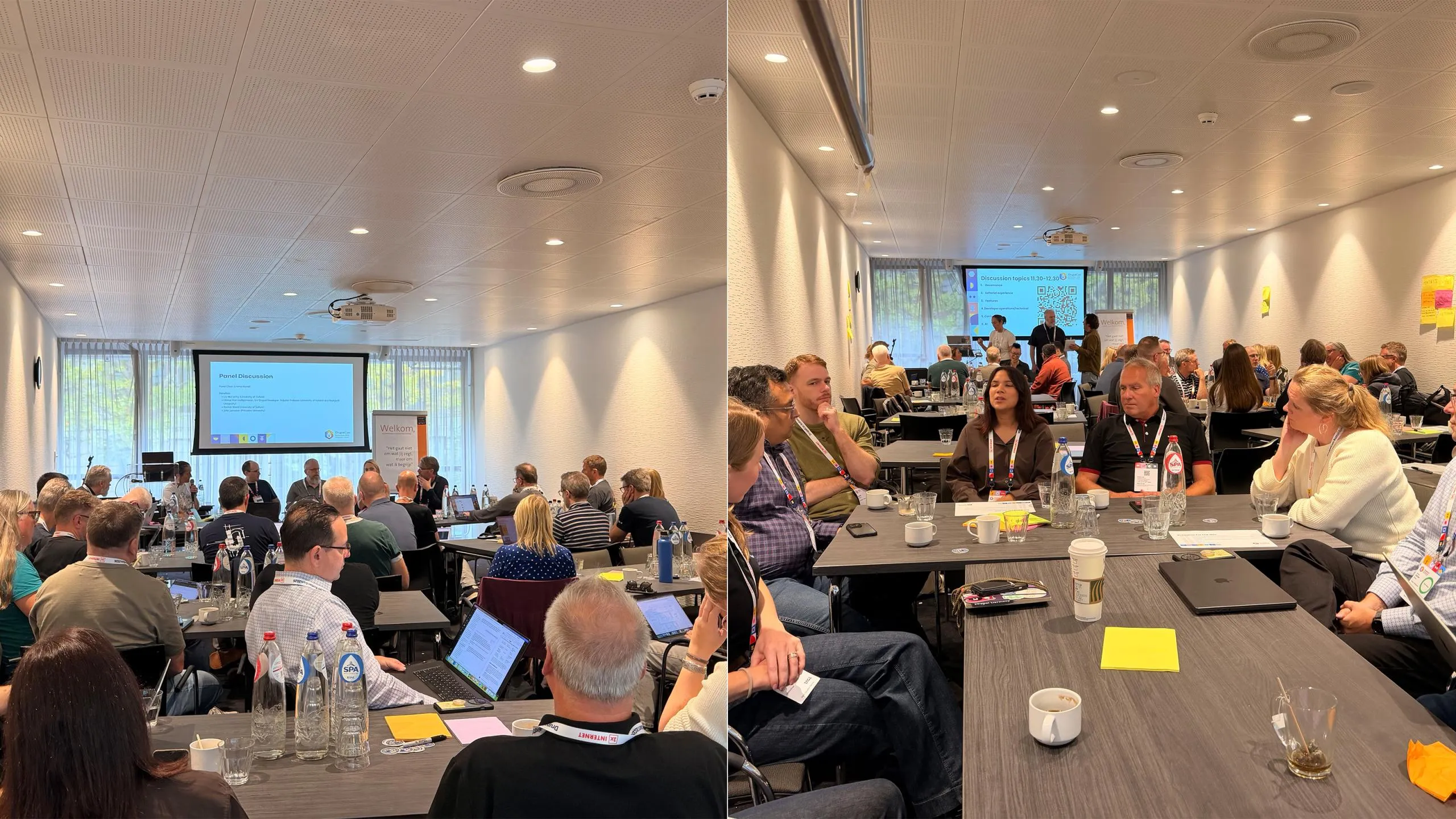
A workshop room full of people working on their laptops in a bright office with large windows

We were right in the thick of it even before it had properly started

The main DrupalCon was preceded by a day of various summits. We split up and attended the Higher Education Summit and the AI Business Summit.

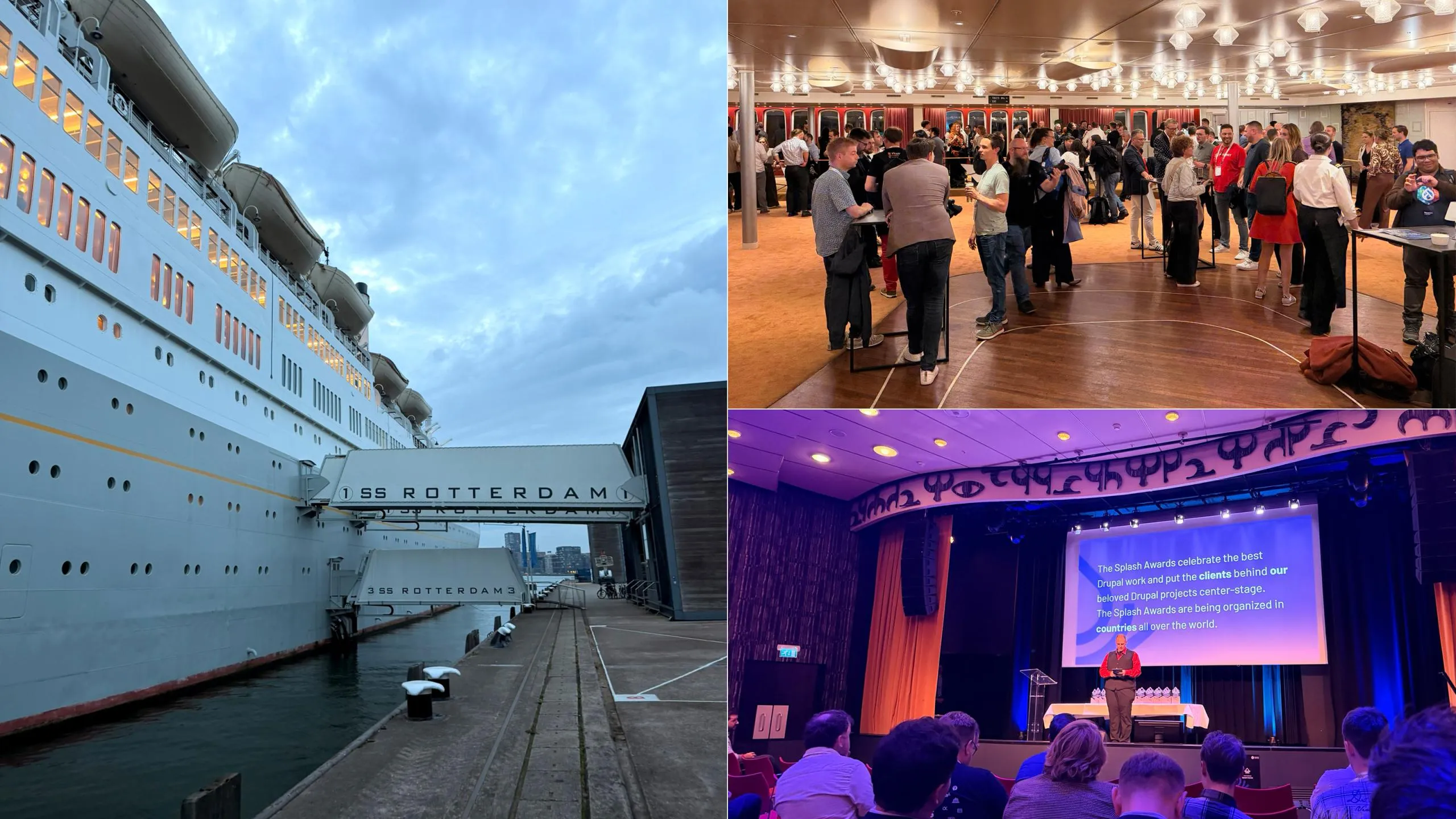
The latter took place on a boat – which meant Rotterdam, as the host city, had already scored a few bonus points on the very first day.

Above all, however, it became clear once again what makes a DrupalCon special, apart from all the sessions: meeting people, sharing experiences, continuing discussions and suddenly finding yourself sitting at a table with people grappling with questions that are surprisingly similar to your own.

Even after the first day, our heads were pretty full – and the list of new contacts was considerably longer.

Do we need to change our mind about Drupal Canvas?

Perhaps.

Up until now, our stance on Drupal Canvas has been rather cautious. For our projects, key requirements were missing, and on top of that there were bugs and a number of unresolved conceptual issues.

Ted Bowman’s (@Tedbow) talk , ‘Advanced Site Building with Drupal Canvas’, has certainly given us food for thought.

Canvas is continuing to evolve. And in such a way that we’ll be taking a closer look at the system again in the near future.

Whether it will actually prove to be the right solution for our type of projects remains to be seen. At the same time, we’re keeping an eye on another interesting development: Display Builder.

But what was once “not relevant to us at the moment” has, in Rotterdam at least, become “we’ll take another look at that”.

That’s something, isn’t it?

Cruise ship from the outside, reception hall with guests, elegant function room with purple lighting

Splash Awards: How the awards ceremony works

At last year’s International Splash Awards, we felt there was still room for improvement.

In Vienna, they were integrated into the conference programme as if they were just another talk. In our view, this didn’t quite do justice to the occasion – especially when you’re familiar with the atmosphere at the Splash Awards in Germany and Austria.

Rotterdam handled it much better. The International Splash Awards took place in the theatre hall of the SS Rotterdam. A dedicated venue, a dedicated setting, a proper awards ceremony. That’s how it should be.

Congratulations to all the winners!

And next time, we’ll be submitting projects again. So brace yourselves.

Collage of two images: Willemsbrug, Rotterdam; cubic houses
A collage featuring four scenes from Rotterdam: the skyline, a bridge, a square and a domed building

And then there’s Rotterdam

Perhaps it doesn’t really matter which city a conference is held in. Or perhaps it does.

In any case, Rotterdam made quite a strong impression.

After large parts of the city were destroyed during the Second World War, Rotterdam was rebuilt – and, architecturally speaking, clearly decided not to set itself too many limits.

Hardly any other European city boasts so many different, unconventional and surprising buildings within such a small area. For people whose work involves design, this is naturally quite interesting.

Thanks to the DrupalJam team for the lunch walk through the city. Using the lunch break to get out and about and discover Rotterdam was a rather good idea.

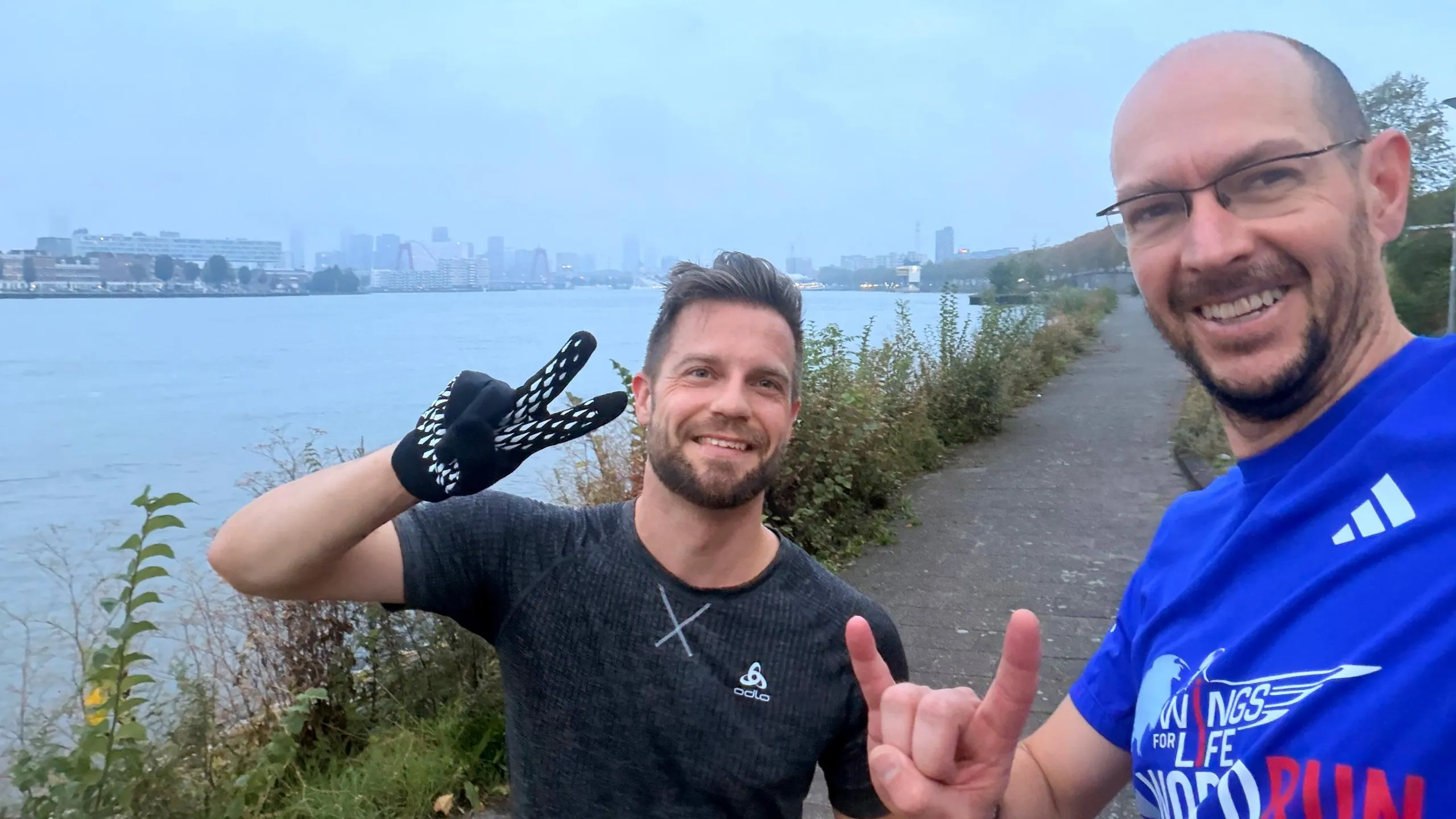
Two smiling men taking a selfie by a lake; one is giving a thumbs-up

Two people make a running group

Speaking of exploring the city.

The programme included a group run through Rotterdam every morning. Starting at 7 am. Sounded good. So I packed my running shoes and headed over. But when I got to the agreed meeting point: no one was there.

As it turned out later, the running group did indeed exist. We just couldn’t find them.

So Christopher and Max just set off on their own.

Rotterdam in the early morning – a pretty empty city and two BRANDCODE runners on their very own DrupalCon Running Tour. It could have gone worse.

What remains?

Lots of new ideas. A few topics we now want to look at more closely. New contacts. A surprisingly vibrant city. And the realisation that Drupal is currently evolving in quite a few areas at once.

AI is changing not just individual features, but interfaces and development processes. Canvas is maturing. The concept of contribution needs to be thought about more broadly. And at the same time, the community is exploring how Drupal is actually perceived outside its own bubble.

Perhaps that is precisely the most interesting insight from Rotterdam:

Technologically speaking, Drupal currently has less to prove than to explain what has long been possible.

That’s something we can work on.